


Amazon Acquires Globalstar for US$11.57 Billion Satellite Expansion

Amazon’s $11.57 billion Globalstar acquisition strengthens its satellite network and accelerates direct-to-device connectivity expansion.
It also intensifies competition with Starlink while highlighting execution challenges despite strong investor confidence.
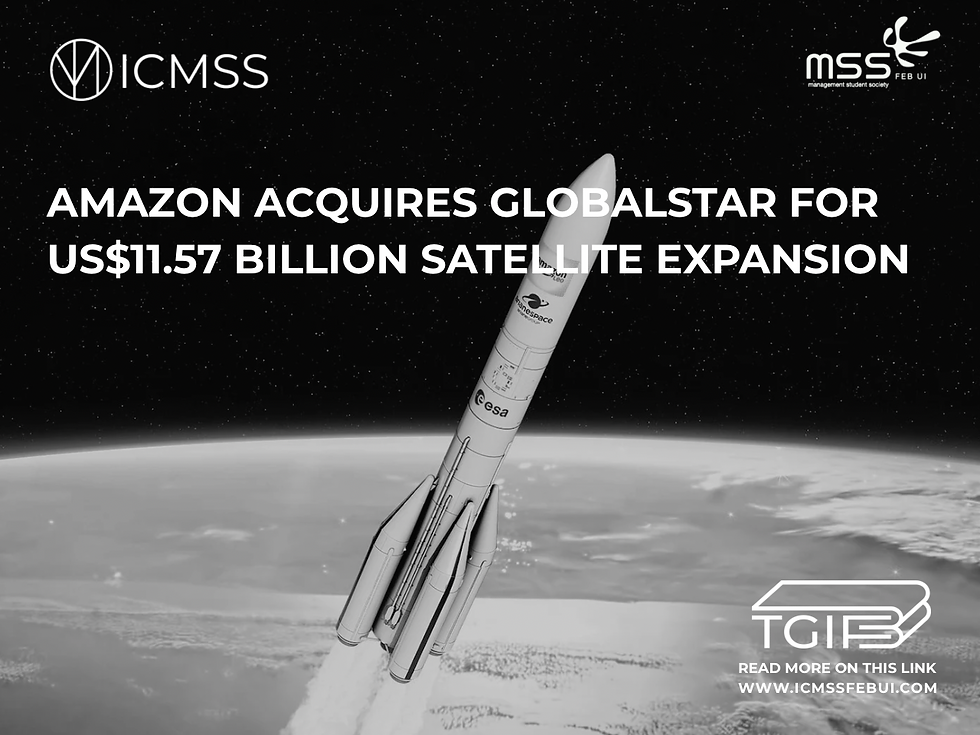
By Emirsyah Kevin Mecca, Attala Sabian Andhika, Maria Ella Risandra Puruhita, Nashwah Putri Az-Zahra
April 17 2026, at 16:30 GMT+7
Amazon announced plans on Tuesday (04/14) to acquire Globalstar in a deal valued at US$11.57 billion.
This acquisition represents a major step in Amazon’s long-term satellite strategy, enhancing its low-Earth orbit (LEO) internet initiative, known as Amazon Leo (formerly Project Kuiper), which aims to deliver global broadband connectivity.
Amazon is accelerating the expansion of its satellite network by planning to deploy around 3,200 LEO satellites by 2029, with nearly half required to meet a regulatory deadline in July, while also preparing to launch its satellite internet services later this year.
According to Panos Panay, Amazon’s senior vice president of devices and services, “By integrating Globalstar's expertise with Amazon’s innovation will deliver faster, more reliable connectivity across more places.”

Amazon Acquires Globalstar | Source: Satnews
The deal adds around two dozen satellites and highly valuable spectrum assets to Amazon’s growing satellite network, including approximately 8 MHz of L-band, 16.5 MHz of S-band spectrum, and about 24 global gateway stations. Amazon will integrate these assets with its existing infrastructure to accelerate the development of advanced connectivity services, particularly in underserved and remote areas.
Globalstar will continue its existing services, including supporting Apple’s Emergency SOS feature, ensuring uninterrupted connectivity for millions of users in remote areas.
Amazon and Apple have signed agreements to expand satellite connectivity across current and future devices, building on Apple’s 20% stake in Globalstar from its US$1.5 billion investment in 2024.
This acquisition is expected to support Amazon’s development of a direct-to-device satellite system, targeted for deployment in 2028, enabling devices to connect without traditional cellular networks and strengthen its competitive standing in the global satellite communications market.

ULA Atlas V rocket prepares to launch Amazon Project Kuiper satellites | Source: CNBC
Despite Amazon’s strategic acquisition of Globalstar, the company still faces challenges in scaling infrastructure, overcoming launch constraints, and accelerating deployment to narrow the gap.
The move places Amazon in direct competition with SpaceX’s Starlink, intensifying the satellite internet race where Starlink maintains a dominant lead due to its larger constellation and user base.
According to Armand Musey, president & founder of Summit Ridge Group, "Amazon has been falling behind Starlink on satellite broadband. Acquiring Globalstar allows them to catch up on their D2D spectrum position, and leap ahead on D2D deployment,".
Meanwhile, SpaceX continues rapid satellite launches, building the world’s largest constellation, with Starlink contributing an estimated 50% to 80% of its revenue. Following the announcement, Globalstar’s shares surged by around 10%, while Amazon’s stock rose around 3%, signaling strong market approval and expectations that the acquisition could strengthen Amazon’s competitive position in the evolving global satellite communications market.
Sources:
CNBC
IDNfinancials
Reuters


Comments